
New Canaan is an inland town in lower Fairfield County. It borders Stamford to the west, Darien and Norwalk to the south, Wilton to the east, and the New York towns of Pound Ridge and Lewisboro to the north. The Merritt Parkway crosses the southern part of town, and the Metro-North New Canaan Branch ends at the downtown station, with a second stop at Talmadge Hill. Assessment, zoning, wetlands, and permits run through the Town of New Canaan. Estates are handled by the Darien–New Canaan Probate Court (Probate District 52), which sits at Darien Town Hall.
For estate attorneys, executors, trustees, CPAs, and matrimonial counsel, New Canaan does not value well from a headline. Most of the town is single-family housing in residence zones named for one-third-acre to four-acre minimum lots, plus two smaller A and B Residence zones. The housing stock runs from 18th- and 19th-century farmhouses to architect-designed mid-century moderns to new construction on rebuilt lots. A quarter of about 70 house sales, or a month of about 13, can swing the median on mix alone. A defensible New Canaan appraisal answers four questions about the specific parcel: what the zone and buildable land allow, how the house fits the town’s product types, whether the existing house still adds value over the land, and which sales actually compete with it on the effective date.
This guide explains how an SRA appraiser works through those questions. It describes appraisal methodology, not legal or tax advice.
What the 2026 New Canaan Numbers Show (and What They Don’t)
The figures below come from two published reports, both built on Connecticut SmartMLS data: the Brown Harris Stevens Q3 2026 Connecticut Market Report (quarter figures) and the SmartMLS Local Market Update for New Canaan, October 2026 (monthly and year-to-date figures, current as of November 8, 2026), with the September 2026 update for the prior month. We checked all three on November 24, 2026.
| New Canaan single-family houses | 2026 | 2025 | Change |
|---|---|---|---|
| Q3 closings | 73 | 70 | +4.3% |
| Q3 median sale price | $2.65M (record) | — | — |
| Q3 average closing price | $3,017,116 | $3,080,601 | −2.1% |
| Q3 closings $3M–$5M | 24 | 16 | — |
| Q3 share sold over asking / median time on market | 64% / 15 days | 53% / — | — |
| Pending on Sept. 30 | 13 | 25 | −48% |
| September median sales price (14 closings) | $2,297,500 | $2,587,500 | −11.2% |
| October median sales price (13 closings) | $3,060,000 | $2,550,000 | +20.0% |
| YTD median sales price (thru Oct.) | $2,805,000 | $2,550,000 | +10.0% |
| YTD closed sales (thru Oct.) | 179 | 184 | −2.7% |
| YTD days on market until sale | 40 | 43 | −7.0% |
| YTD percent of list price received | 105.2% | 103.5% | +1.6% |
| Inventory / months supply (October) | 40 / 2.4 | 40 / 2.2 | 0.0% / +9.1% |
Sources: Brown Harris Stevens, Q3 2026 Connecticut Market Report, New Canaan overview (data from Connecticut SmartMLS; no guaranty of accuracy is made); SmartMLS Local Market Updates, New Canaan, September and October 2026 (© 2026 ShowingTime Plus, LLC; figures do not account for sale concessions). Q3 and pending rows are from Brown Harris Stevens; monthly, YTD, inventory, and months-supply rows are from SmartMLS. A dash means the figure was not published in that source.
Read the rows together before quoting the headline. Brown Harris Stevens reported a record Q3 median of $2.65 million, driven by 24 closings between $3 million and $5 million against 16 a year earlier. In the same quarter, the average closing price fell 2.1%. A record median and a lower average in the same 73 sales is a sign that the middle of the distribution moved while the top did not, which is a statement about what sold. The monthly figures make the same point more sharply: the September median was down 11.2% on 14 closings, and the October median was up 20.0% on 13 closings. Neither month is the change in any one house’s value. An appraiser does not apply a town median change as a time adjustment. Time adjustments come from paired sales, resales of the same property, or a segmented price-per-square-foot trend for the subject’s own product type and price band.
The other rows describe the pace of the market. Year to date through October, houses sold in 40 days on average against 43 a year earlier, and buyers paid 105.2% of list price. In Q3, 64% of house closings went over asking, with a median of 15 days on market. Inventory in October was unchanged from a year earlier at 40 houses, about 2.4 months of supply, while pendings on September 30 were roughly half the prior year’s count. Those are statements about price, inventory, days on market, sale-to-list ratio, and volume. They support a firm price environment through October, with signs of a slower pipeline into year-end. They do not replace evidence about the specific property.
New Canaan Zoning: Seven Residence Zones and a Coverage Formula
New Canaan’s residence zones are named for their minimum lot area. Per Section 3.5 of the Town of New Canaan Zoning Regulations (posted edition as amended effective May 1, 2023):
- Four Acre Residence Zone: 174,240 sq. ft. minimum lot area
- Two Acre: 87,120 sq. ft.
- One Acre: 43,560 sq. ft.
- One-Half Acre: 21,780 sq. ft.
- One-Third Acre: 14,520 sq. ft.
- A Residence: 10,000 sq. ft.
- B Residence: 7,500 sq. ft.
Three features of the regulations matter more to value than the minimum lot size itself:
- Building coverage is a sliding formula, not a flat percentage. Allowed coverage steps up with lot area. For a lot of one acre up to just under two acres, for example, it is 3,485 sq. ft. plus 4% of the lot area over 43,560 sq. ft. The effective percentage falls as lots get larger, so a lot twice the size of its neighbor does not support a house twice the size. For a buyer who plans to rebuild, the allowable house is what is being bought, and the appraiser runs the formula, setbacks, and height rules for the actual parcel.
- Density is measured on buildable land. In the One-Half Acre, One-Third Acre, A, and B zones, the number of lots a parcel can be divided into is capped per acre of buildable land. Buildable land excludes wetlands, watercourses, the 100-year floodplain, and slopes steeper than 25%. A parcel that looks divisible on gross acreage may not be once those areas are taken out, and subdivision potential that is not legally and physically supportable on the effective date is not valued as if it were approved.
- Adjoining nonconforming lots can merge. The regulations treat adjoining lots that are or have been in single ownership as one undivided parcel when one of them is nonconforming as to minimum lot area. In an estate, a “separate” lot next to the decedent’s house is a frequent source of disagreement. Its status is confirmed from the land records and zoning history before any separate building-lot value is assigned.
The Planning and Zoning Commission is in a multi-year rewrite of the regulations. New commercial, downtown, parking, and inclusionary zoning rules were adopted effective July 1, 2026, and residence-zone changes were under review this fall, per the Town’s zoning update page. For a retrospective value, the zone and the rules in effect on the effective date control, not a later amendment.
Housing Stock: Separate Products Inside One Town
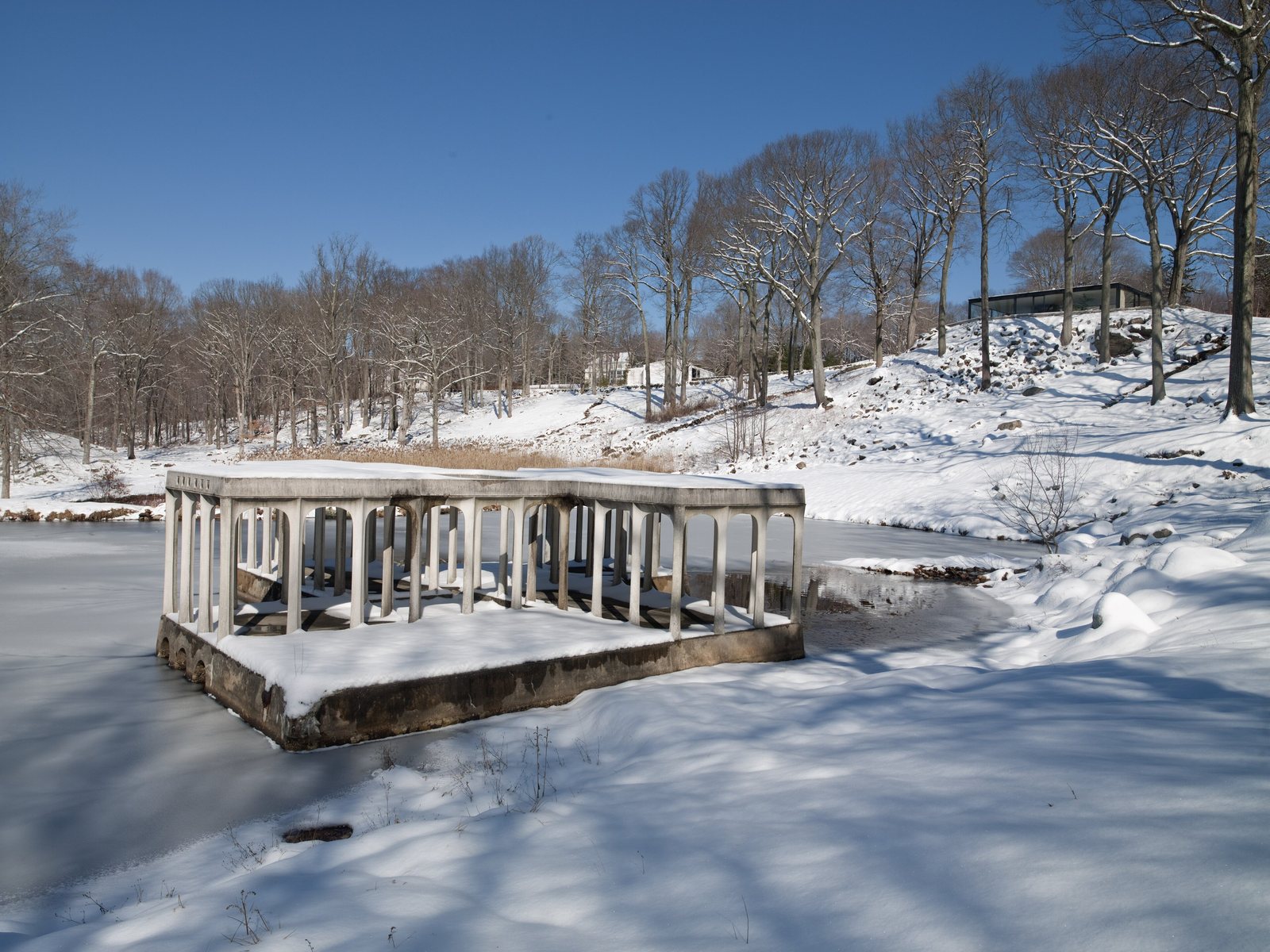
New Canaan is known for its concentration of mid-century modern houses, including Philip Johnson’s 1949 Glass House (pictured above), now a National Trust for Historic Preservation site. Those houses share the market with antique colonials and farmhouses, mid-20th-century colonials and capes on one- and two-acre lots, large post-2000 houses, and condominiums and townhouses near the village. An appraiser sorts the subject and every candidate comparable into a product type before adjusting anything:
- Mid-century and architect-designed moderns: Buyer demand for an intact, well-maintained modern can differ sharply from demand for an altered or deteriorated one, and from demand for the land under it. Sales of comparable moderns are thin, so the appraiser widens the time window with supported time adjustments and documents any design premium or discount from actual sales, not from the house’s reputation. Any historic designation, easement, or deed restriction is read from the recorded documents because it can limit what a buyer may change.
- Antique houses: Ceiling heights, floor plans, systems, and the condition of original fabric drive value. Age alone is not a premium or a penalty.
- Mid-century colonials and capes on larger lots: Often the teardown-or-renovate segment. Value depends on whether the market is paying for the house or for the land and the allowable rebuild.
- Newer large houses: Quality, finish level, and the relationship between house size and lot size under the coverage formula drive adjustments.
- Condos and townhouses: A separate market with its own sale set. Brown Harris Stevens reported 28 Q3 condo closings with a record median of $1.53 million, and 82% sold over asking. SmartMLS showed 18 condos for sale in October against 11 a year earlier.
Septic, Wells, Wetlands, and Outbuildings
- Utilities: Outside the village area, many New Canaan houses rely on private septic systems and wells. Septic capacity and condition can limit bedroom count and rebuild size, so the file records the system type, the design bedroom count where available, and any recent inspection.
- Wetlands and watercourses: Inland wetlands and steep slopes reduce buildable land and can constrain additions, pools, and outbuildings. A survey showing delineated wetlands is one of the most useful documents in a New Canaan file.
- Accessory dwellings and guest houses: The regulations allow a second dwelling unit on a lot only with approval of an accessory dwelling unit or guest house. A cottage or apartment contributes at full value only when it is permitted for that use.
- Measured, not assumed: Whether buyers discount a septic system, a busy road, or a wetland setback, and by how much, is measured from local sales, never applied as a fixed percentage.
Teardowns, Renovations, and Highest and Best Use
- When the house still contributes: A standard sales comparison, with quality and condition ratings, systems age, and permitted additions driving the adjustments. See how high-end renovations are credited.
- When the market pays for the land: Teardown sales, meaning improved properties bought for demolition, are often better land evidence than the few vacant-lot sales. Demolition cost, the coverage formula, setbacks, wetlands, and septic capacity for the new house all apply. See vacant land appraisal.
- Permits and certificates of occupancy: Additions, finished lower levels, and converted barns or garages contribute at full value only when permitted. Below-grade area is never counted as above-grade living area.
- As-is estate condition: An estate house that has not been updated in decades is valued as it stood on the date of death, not as it might be after a renovation. See appraising an estate home that needs work.
Comparable Selection: New Canaan, Its Neighbors, and Price Tier
- Inside New Canaan first: With 179 single-family closings through October, New Canaan usually supplies its own comparables. The cleaner fix for a thin bracket, such as a four-acre property or an intact modern, is a wider time window with supported time adjustments, not a wider radius.
- Price tier matters: Q3 sales clustered between $3 million and $5 million, and the top and bottom of the market move at different speeds. Comparables are drawn from the subject’s own price band and product type.
- Darien, Wilton, and Stamford: Southern New Canaan sometimes competes with northern Darien, and the eastern and western edges with Wilton and north Stamford. All are separate markets and need location adjustments the data actually shows. See appraising Darien and appraising Stamford.
- Across the state line: Pound Ridge and Lewisboro sit directly north, but New York and Connecticut have different property tax structures and transfer costs. Their sales need disclosed support. See appraising Pound Ridge.
- Effective-date discipline: For a retrospective value, only sales that had closed or were knowable by the effective date belong in the analysis.
In New Canaan, the comparable is defined by zone and buildable land, product type, and price tier, in roughly that order, before distance. A September median down 11.2% and an October median up 20.0%, each on about a dozen sales, show how much the mix moves. Neither is the change in any one house’s value.
Assessments Are Not Appraisals
Connecticut assesses real property at 70% of market value as of the town’s last revaluation date. A New Canaan assessment card is a useful source for lot size, year built, and recorded improvements, but dividing the assessment by 0.70 does not produce a date-of-death, divorce, or gift value. The revaluation date may be years before the effective date, and mass appraisal does not inspect for condition, measure buildable land, or account for a modern’s design. Counsel should expect the appraisal and the grossed-up assessment to differ, sometimes widely.
What Helps an Appraisal in New Canaan
- Survey or plot plan showing lot lines, setbacks, easements, delineated wetlands, and any floodplain
- The zone and any variances, special permits, or nonconforming-lot history on record
- Deeds for any adjoining parcel in the same ownership
- Septic design and inspection records, and well test results if available
- Permit and certificate-of-occupancy history for additions, finished lower levels, accessory apartments, and outbuildings
- Any historic designation, preservation easement, or deed restriction
- For estate, divorce, or gift files: the required effective date and the intended users (attorney, executor, trustee, or CPA)
Private Assignments in New Canaan
- Estate / date-of-death: Retrospective fair market value as of the date of death or alternate valuation date for Form 706, the Connecticut estate tax return, the Darien–New Canaan Probate Court inventory, trust administration, and stepped-up basis. The report uses only sales knowable on that date, plus the zoning rules then in effect. See Fairfield County estate and probate appraisal, Connecticut estate appraisal, and date-of-death appraisal.
- Divorce / dissolution: Current or retrospective values of a marital home for Connecticut dissolution matters, including buyouts where one spouse keeps the house. Counsel needs a USPAP-compliant private report, not a CMA or automated estimate. See divorce appraisal in Connecticut, Connecticut divorce appraisal, and one neutral appraiser or two.
- Gifts and trusts: Values as of the gift date for Form 709 and the Connecticut gift tax return, for transfers to a trust or a QPRT, and for partial-interest gifts, prepared for review by the client’s CPA and counsel. See gift appraisals for Form 709 and QPRT appraisals.
- Estate sale under contract: When the decedent had already signed a contract to sell, the contract price is evidence, not automatic fair market value. See estate appraisals when the home was under contract at death.
Madison & Park Appraisal is Licensed in Connecticut, and Dave Lister holds the SRA designation from the Appraisal Institute. We prepare USPAP-compliant reports and have experience with date-of-death and other retrospective assignments in New Canaan, Darien, Greenwich, Stamford, and across Fairfield County. Each report states its intended use and intended users and documents the evidence behind every adjustment. For the county-level overview, see our Fairfield County private appraisal guide. Attorney intake details are on our For Attorneys page.
Frequently Asked Questions
Can I use the New Canaan median price change to update an older appraisal?
No. New Canaan closes only about a dozen to two dozen houses a month, so the monthly median swings on the sales mix. The September 2026 median fell 11.2% year over year and the October median rose 20.0%. A defensible update uses paired sales, resales, or a segmented trend for the subject’s own product type and price band.
Does a large New Canaan lot have subdivision value?
Only if a division is legally and physically supportable on the effective date. In the smaller residence zones, New Canaan caps lots per acre of buildable land, which excludes wetlands, watercourses, the 100-year floodplain, and slopes over 25 percent. Otherwise the extra land is valued as part of one lot, adjusted for its utility.
Is a vacant lot next to the decedent’s New Canaan house a separate building lot?
Not necessarily. Under New Canaan’s zoning regulations, adjoining lots that are or were in single ownership can be treated as one undivided parcel when one of them is nonconforming as to lot area. The appraiser confirms the lot’s status before assigning it separate building-lot value.
Can Darien, Wilton, Stamford, or Pound Ridge sales be used for a New Canaan home?
Sometimes, with disclosed support. They are separate markets, and Pound Ridge is in New York with a different tax structure. They are typically used when New Canaan sales of the same product type, zone, and price band are not available for the effective date.
Can you appraise a New Canaan home as of a past date?
Yes. Retrospective appraisals as of a date of death, alternate valuation date, dissolution date, or gift date are a core part of our private work. The report uses only sales and market data that were knowable as of that effective date.
Final Thoughts
New Canaan prints record medians, but appraisal results depend on details that differ parcel by parcel: the zone, buildable land, and coverage formula; whether an adjoining lot is truly separate; the product type, from antique to modern to new; septic and wetland constraints; whether the house still contributes value; and comparables from the same product type and price tier. The 2026 data shows above-list pricing, quick sales, and steady inventory. That is useful context for the effective date. It does not replace property-specific evidence.
Need an Appraisal in New Canaan?
For estate and date-of-death, divorce, trust, gift, or private valuation, we provide USPAP-compliant appraisals across New Canaan and Fairfield County. Licensed in Connecticut, SRA-designated.
Get a Free QuoteHero photo: Philip Johnson’s Glass House, New Canaan, Connecticut, by Carol M. Highsmith (Carol M. Highsmith Archive, Library of Congress), via Wikimedia Commons, public domain; cropped and resized.
← Back to Insights